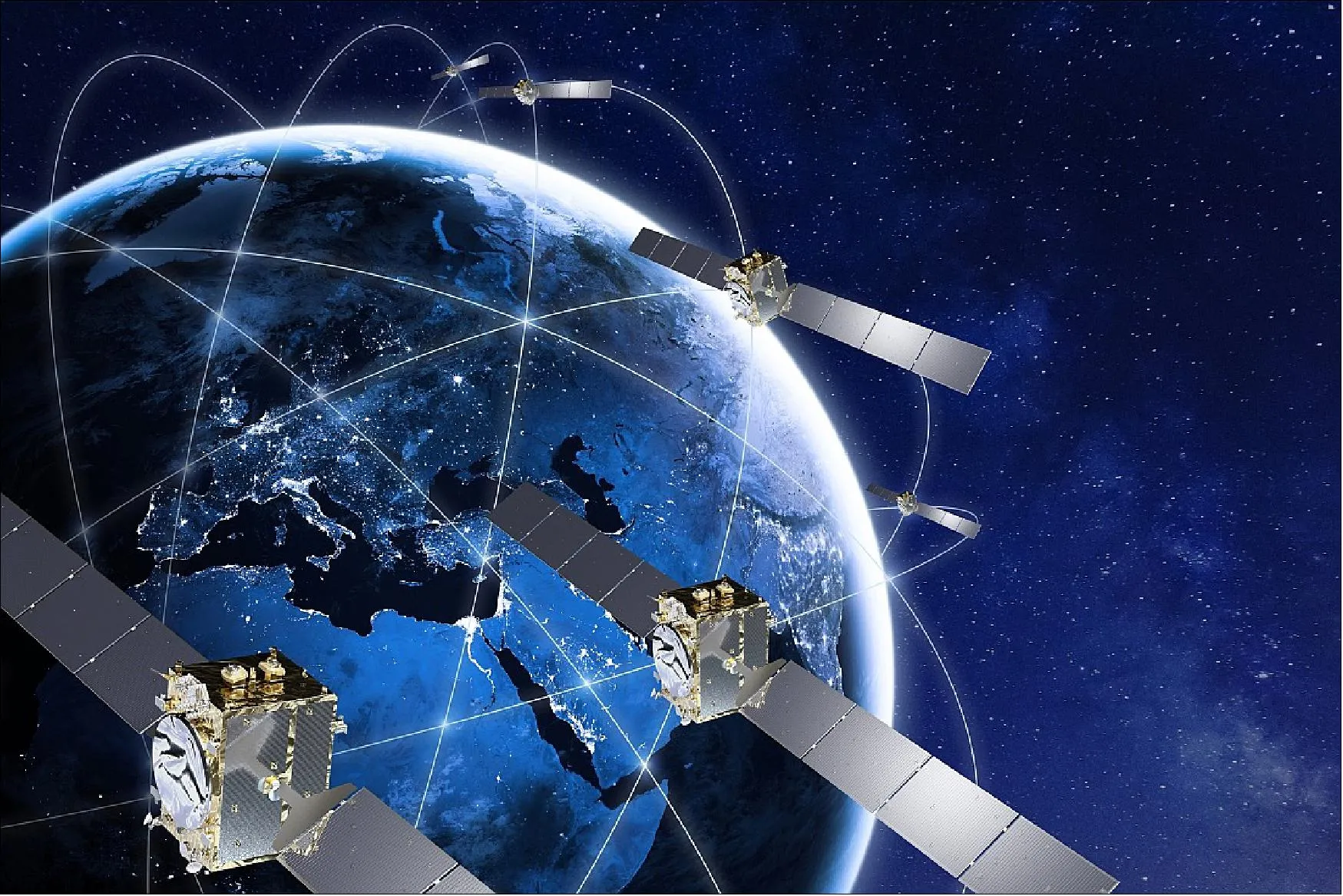
Galileo Second Generation (G2G) is not a mid-life refresh of the current constellation. It is a new satellite platform built around a fully digital, in-orbit reconfigurable navigation payload, a larger and more diverse atomic-clock ensemble, inter-satellite links and electric propulsion. Where Galileo First Generation (G1G) bakes its signals into fixed hardware, G2G turns them into software you can update on orbit, with the bandwidth for faster fixes and stronger authentication.
The industrial shape: twelve G2G satellites, two families of six, are being built by Thales Alenia Space in Italy and Airbus Defence and Space in Germany. eoPortal puts the May 2021 procurement at €1.47 billion for the twelve, with the Thales Alenia Space share (six satellites) at €772 million.
Galileo Second Generation vs First Generation: the spec delta
| Attribute | Galileo First Generation (G1G) | Galileo Second Generation (G2G) |
|---|---|---|
| Navigation payload | Fixed-hardware signal generation | Fully digital, reconfigurable in orbit |
| Atomic clocks | 4 per satellite (2 PHM + 2 RAFS) | 6 per satellite; new optical and ion technologies |
| Inter-satellite links | None | Optical, two terminals per satellite |
| Propulsion | Chemical | All-electric |
| Satellite mass | ~730 kg (FOC platform) | ~2.3 tonnes |
| Design life | ~12 years | ~15 years |
| Orbit | Medium Earth Orbit, 23,222 km | Same MEO shell, fleet-compatible |
| Signal plan | E1, E5, E6 as built | E1/E5/E6 plus new Quasi-Pilot and data components |
| First deployment | 2011 to 2016 | Expected 2027 |
The through-line: G2G keeps everything about Galileo that receivers already depend on (the orbit, the bands, the message framework) and rebuilds everything underneath it that was previously frozen at launch.
Why a reconfigurable digital payload
On G1G, signal generation is fixed in hardware. To change a signal, you build and launch new satellites. That is a decade-scale feedback loop against threats and standards that move far faster.
G2G’s navigation payload is fully digital and reconfigurable in orbit. Airbus describes payloads that can be “easily reconfigured in orbit… with novel signals and services,” and the enabling architecture, set out in ESA’s signal-evolution work, is direct L-band digital signal generation: the ranging signals are synthesised in software rather than by fixed analogue chains. eoPortal characterises the solution as flexible and modular, built on telecom-style signal-generation elements. The design goal ESA has stated for this flexibility is blunt: cut the time-to-market for a new signal or service from the roughly 15-year cadence of satellite replenishment down to something closer to 6 to 12 months.
That is not a slide-deck promise. It is already happening on the current fleet. ESA reconfigured a subset of in-orbit G1G satellites to broadcast a new E5a Quasi-Pilot (QP) signal, reaching twelve satellites by April 2026, and reports it cuts signal-acquisition time roughly threefold and processing load roughly eightfold for low-power and snapshot receivers. A new signal component, uploaded to satellites launched a decade ago, is the reconfigurable-payload thesis proven before the first G2G satellite has even flown.
The G2G signal plan: Quasi-Pilot signals and new data components
The headline signal change in G2G is the Quasi-Pilot layer, specified in EUSPA’s “G2 Evolution of Quasi-Pilot Signals and Interface Control Information” document (Issue 1.0, December 2025). QP components are low-complexity pilot signals added on top of the legacy E1/E5/E6 baseline:
| QP component | Center frequency | Modulation |
|---|---|---|
| E1-QP1 | 1576.443 MHz | BPSK(1) |
| E1-QP2 | 1597.926 MHz | BPSK(1); BOC(1,1) under assessment |
| E5c-QP | 1182.588 MHz | BPSK(1) |
All three use 1023-chip Gold codes at 1.023 Mchip/s (some parameters in that December 2025 document are still marked as pending final confirmation). Binary Phase-Shift Keying, BPSK(1), keeps the correlators cheap, which is the point: these signals exist so that a smartphone, an Internet of Things tracker, a drone or an automotive receiver can lock on fast at low power.
Two capabilities ride on top and are worth an integrator’s attention:
- Time Dissemination Scheme (TDS). A single QP signal can resolve a receiver’s coarse time to within a ±2.4 second ambiguity in under 248 milliseconds, using Variable Transition Phasing symbols (240 ms symbols whose transition position encodes the time state). That is a stand-alone fast time-synchronisation capability new to Galileo, useful precisely for snapshot and assisted receivers that wake, fix and sleep.
- Quasi-Pilot Health Status (QHS). Overlay codes let a receiver read a signal’s health without demodulating the full navigation message, shaving latency off the decision to use or discard a satellite.
Alongside the pilots, G2G adds new high-rate data components carrying a flexible message, targeting faster Time-To-First-Fix-Data (TTFFD) through improved almanac and long-term ephemeris delivery. None of this breaks the past: ESA has demonstrated G2G’s compatibility with G1G signals, and the QP material is published as a complement to the Open Service signal-in-space interface document, not a replacement. Legacy E1/E5/E6 receivers keep working unchanged; every new component is opt-in.
How much better are the G2G clocks?
Clock stability is the dominant term in the broadcast ranging budget. A navigation satellite is, first, a clock in orbit; every nanosecond of clock-prediction error between ground updates becomes centimetres of ranging error at the receiver.
According to ESA, each G1G satellite carries four clocks: two Passive Hydrogen Masers (PHM), the most stable references and the operational masters, and two Rubidium Atomic Frequency Standards (RAFS) as backups, from Leonardo and Safran. ESA’s own yardstick: the PHM would lose about one second in three million years, the RAFS about three seconds in one million years. G2G raises the count to six clocks per satellite and diversifies the physics. From a seven-way development, three technologies advanced to hardware: a Rubidium Pulsed Optically Pumped clock (Leonardo, Italy), an Iodine Optical clock (SpaceTech, Germany), and a Mercury Ion clock (Safran). Treat those as the development and experimental-flight slate rather than a finalised flight manifest; ESA has not published Allan-deviation figures for the new clocks, and the stated ambition is a timing performance roughly twice that of the current FOC satellites.
Why it matters downstream: a more stable onboard reference shrinks the clock error that accumulates between ground uploads. Pair that with the fresher updates that inter-satellite links allow, and the age of the broadcast clock, one of the least visible but most stubborn error sources, comes down.
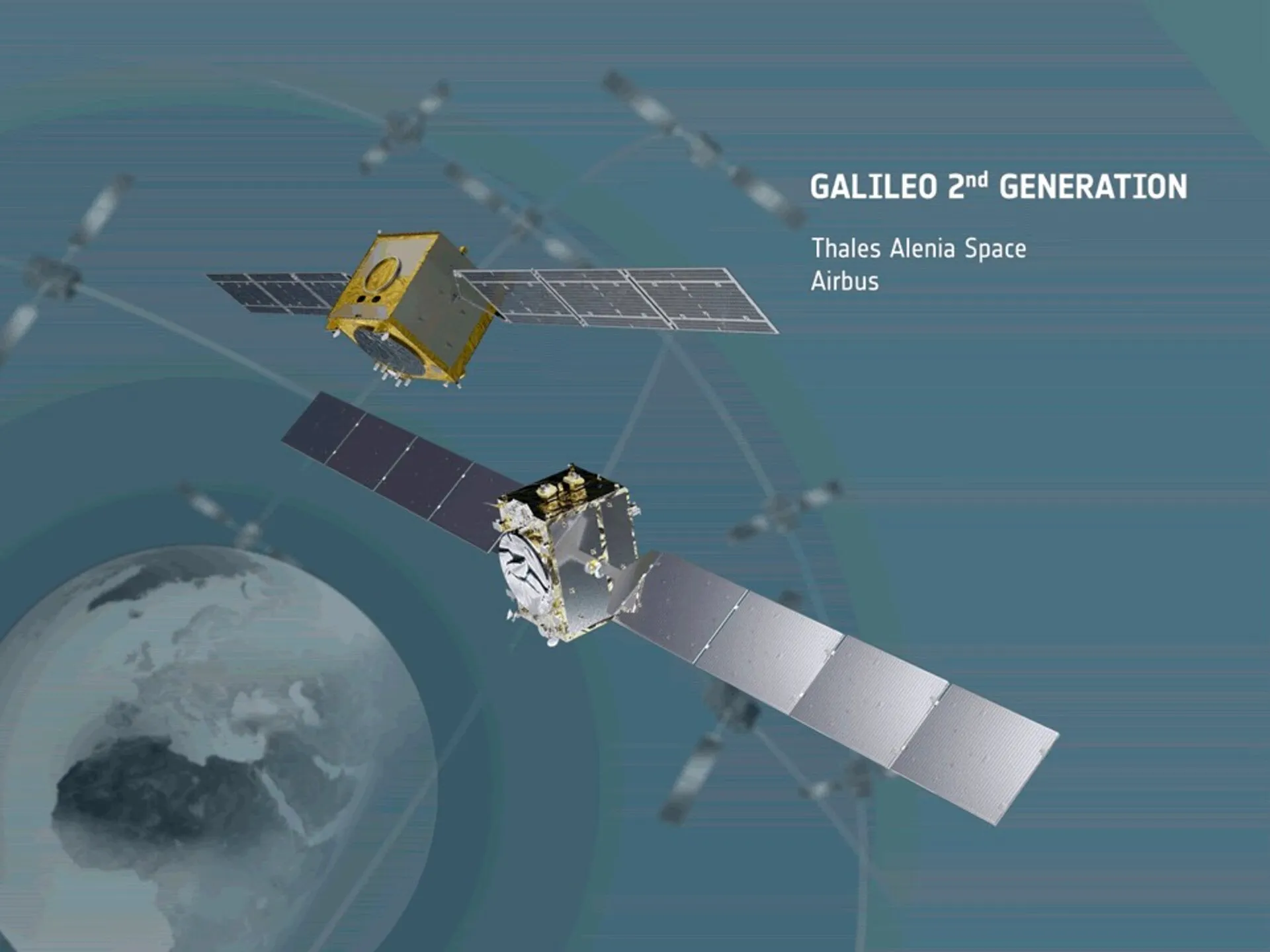 G2G keeps Galileo’s Medium Earth Orbit shell and signal bands, and rebuilds the payload, clocks and platform underneath. Photo by ESA.
Conversations in the sky: optical inter-satellite links
G1G leans on the ground segment. Orbits and clocks are determined and refreshed via a network of sensor and uplink stations, and the quality and age of that data bounds how good the broadcast corrections can be estimated and the frequency of their update.
G2G adds Inter-Satellite Links (ISL), and a detail worth correcting up front: Galileo’s ISLs are optical, not radio-frequency. ESA selected optical inter-satellite links because they carry far higher data rates, need no International Telecommunication Union frequency coordination, resist interference and jamming better, and draw on flight heritage from the Copernicus Sentinels and the European Data Relay System. Each G2G satellite carries two ISL terminals. The antenna pointing mechanism reorients to a different satellite roughly every 40 seconds, which works out to on the order of 12 to 15 million reorientations across the 15-year life. That endurance is exactly what ESA has been qualifying on the ground: a pointing mechanism from Beyond Gravity survived a seven-month test reorienting 15 million times, finishing in March 2026, while Tesat integrates the terminals and MDA in Montreal ran flight-model testing.
The operational payoff is a constellation that measures itself. ISLs add time-synchronisation and ranging measurements between satellites, sharpening knowledge of each spacecraft’s orbit and clock offset, and they let data reach a satellite that no ground station can currently see. That reduces dependence on ground contact and moves Galileo toward autonomous orbit determination. ESA’s signal-evolution studies frame the target as ranging two to five times better than FOC and open-service positioning trending toward sub-metre, with ISL ranging cited as an enabler; read those as programme targets rather than committed specifications. For a European system built with resilience in mind, autonomy from a single ground failure point is as much the goal as the raw accuracy gain.
A bigger bus: electric propulsion, mass and life
The platform grows to match the payload. G2G satellites weigh around 2.3 tonnes, against roughly 730 kg for the current Full Operational Capability (FOC) satellites, and adopt all-electric propulsion for orbit raising, a first for Galileo. Electric propulsion trades a slow spiral up to Medium Earth Orbit, reportedly on the order of months rather than the weeks a chemical stage needs, for far better propellant efficiency, and it still supports a dual-satellite launch despite the higher mass. Design life extends to about 15 years, the clock bay grows from four to six, and the navigation antenna gets a larger radiating area and more power.
Rebuilding the ground segment
The part of G2G that never shows up in a satellite photo is the ground segment, and it is being rebuilt in parallel. GMV is delivering the G2G Ground Control Segment under an ESA contract worth more than €200 million, introducing post-quantum cryptography, a microservices architecture and heavier automation. The plan is to unify control of the first and second generations into one segment able to manage the full constellation, on the order of 50 satellites, by the end of 2026. So far unclear if it will be achieved due to the vast differences in the ground segments among the two generations. Thales Alenia Space holds the Ground Mission Segment work. Governance sits with EUSPA as system prime, with ESA running the major space and ground procurement on its behalf, and a new Galileo Security Facility at the security monitoring centres underpins the evolved Public Regulated Service.
Authentication and high accuracy in the G2G era
G2G’s digital payload and extra bandwidth are what let services deepen over the constellation’s life. Four are worth knowing in detail, and two are already live.
OSNMA. Open Service Navigation Message Authentication became freely available worldwide on 24 July 2025, according to EUSPA, after a public observation phase running since November 2021. It authenticates the E1-B I/NAV navigation message using a delayed-disclosure (TESLA) scheme carried in previously reserved message fields, so there is no navigation-performance penalty, and a receiver needs a 30-to-300-second time synchronisation to verify. It is a direct, no-cost defence against a common class of spoofing.
HAS. The Galileo High Accuracy Service, per EUSPA’s December 2025 information note, broadcasts corrections on the E6-B data component at 448 bits per second per connected satellite, in a format close to Compact State Space Representation, plus an internet delivery path. Its global level (SL1) carries orbit, clock and code and phase biases for Galileo and GPS; the European level (SL2) adds ionospheric corrections. Targets are better than 20 cm horizontal and 40 cm vertical at 95%, with convergence under 300 seconds globally and under 100 seconds in Europe, at 99% availability. Initial Service has run since 24 January 2023; full-service operational capability is targeted for late 2026 with a declaration, including HAS authentication, in the first half of 2027. It is, in effect, a free correction stream, exactly the kind of state-space correction that gets distributed to applications over standard protocols.
SAS. The planned Signal Authentication Service adds ranging authentication on the E6-C pilot component, complementing OSNMA. In the published design, parts of the E6-C code are re-encrypted with future OSNMA keys as Re-Encrypted Code Sequences held on a Galileo server; a receiver snapshots E6-C and correlates after the key is disclosed, on a 30-second authentication interval, and can run autonomously for up to seven days on downloaded sequences. It closes the gap OSNMA leaves open: OSNMA authenticates the data, SAS authenticates the ranging.
EWSS. The Emergency Warning Satellite Service turns the constellation into an alert-broadcast layer. Per EUSPA’s December 2025 message-format specification, alerts are carried in the Open Service I/NAV data on E1 and E5b as a 122-bit Common Alert Message Format that encodes hazard type, severity, onset and a target area defined as one or more geographic ellipses, aligned with the Common Alerting Protocol. National civil-protection authorities generate the alerts through the emergency alerting infrastructure, with the service expected operational across 2025 and 2026.
Where G2G stands in mid-2026
G2G has moved from design into hardware. ESA reports the System Compatibility Test Campaign began at Thales Alenia Space in Rome in September 2024 and continued at Airbus in Friedrichshafen in February 2025, with a navigation-antenna acceptance test at Getafe in March 2025. The optical-link pointing-mechanism endurance run finished in March 2026, and the E5a Quasi-Pilot reconfiguration reached twelve in-orbit satellites by April 2026. In May 2026, the European navigation community gathered at ESA’s ESTEC in Noordwijk for NAVITEC 2026, the twelfth ESA Workshop on Satellite Navigation Technologies, with resilient and multi-layered Positioning, Navigation and Timing (PNT) high on the agenda, the backdrop against which this G2G progress is being reported. For context on the current baseline, the in-service Galileo constellation stood at roughly 33 satellites, 25 of them usable, with metre-level open-service accuracy in early 2026.
When does Galileo Second Generation launch?
The first four G2G satellites fly on Ariane 6 across two missions, Galileo L17 (the first pair) and Galileo L18 (the second). EUSPA signed the L18 launch contract on 27 January 2026, its fifth Galileo Ariane 6 mission, with the L17 contract predating it. ESA and Arianespace still describe the first four launching “in 2026 and 2027,” but the manifest signals a slip: first-generation launches remain queued ahead of them, and public satellite trackers now place both L17 and L18 in 2027, so the first G2G launch has most likely moved into 2027. Ariane 6 has already flown Galileo, lofting the first-generation L14 pair on 17 December 2025 with injection accuracy EUSPA described as twice as good as the previous Falcon 9 missions. Read the dates as plans on public record, not fixed commitments; launch manifests move. The reassuring part for anyone with fielded equipment is that G2G joins the existing constellation gradually and interoperably, so the transition is measured in incremental capability rather than a switchover.
Frequently asked questions
What is Galileo Second Generation (G2G)?
Galileo Second Generation is the next Galileo satellite platform, replacing fixed-hardware signal generation with a fully digital, in-orbit reconfigurable navigation payload. G2G adds optical inter-satellite links, six atomic clocks per satellite including new optical and ion technologies, all-electric propulsion, a longer design life, and new Quasi-Pilot signals for faster fixes, while staying compatible with the current fleet.
What is the difference between Galileo first and second generation?
G1G signals are fixed in hardware and updated only by launching new satellites; G2G’s payload is reconfigurable in orbit. G2G also adds optical inter-satellite links, new clock technologies (four clocks become six), all-electric propulsion, roughly triple the satellite mass, about 15 years of design life, and new Quasi-Pilot signal components. Both share the same Medium Earth Orbit shell and E1/E5/E6 framework.
What new signals will Galileo G2G broadcast?
G2G keeps E1, E5 and E6 and adds Quasi-Pilot components: E1-QP1 at 1576.443 MHz, E1-QP2 at 1597.926 MHz, and E5c-QP at 1182.588 MHz, all low-complexity BPSK pilots on 1023-chip Gold codes, plus new high-rate data components. They speed acquisition and time synchronisation for low-power receivers. An interim E5a Quasi-Pilot already runs on a subset of current satellites.
Are Galileo’s inter-satellite links optical or radio?
Optical. ESA selected optical inter-satellite links for G2G because they offer higher data rates, need no radio-frequency coordination, and resist jamming better, drawing on Sentinel and European Data Relay System heritage. Each G2G satellite carries two terminals whose pointing mechanism reorients about every 40 seconds. The links let satellites range and synchronise with each other, improving orbit and clock knowledge and cutting ground dependence.
When will the first Galileo Second Generation satellite launch?
The first four G2G satellites are manifested on Ariane 6 as missions Galileo L17 and L18, with the L18 contract signed on 27 January 2026. ESA and Arianespace describe them launching across 2026 and 2027, but the manifest points to the first G2G launch most likely slipping into 2027. These are published plans and can shift with the launch schedule. Historically more realistic in such setups, leads to 2028 or 2029 for the first satellite in orbit.
Who is building the Galileo Second Generation satellites?
Twelve G2G satellites are being built as two families of six, by Thales Alenia Space in Italy and Airbus Defence and Space in Germany, under a procurement ESA and the European Commission awarded in May 2021. eoPortal puts the contract at €1.47 billion for the twelve. GMV is building the new ground control segment, and Tesat, Beyond Gravity and MDA supply the optical inter-satellite link hardware.
How accurate is Galileo Second Generation?
Today’s Galileo open service delivers metre-level positioning, and the free High Accuracy Service already reaches better than 20 cm horizontal for equipped receivers. G2G’s improved clocks, optical inter-satellite links and new signals target ranging several times better than the current satellites and open-service positioning trending toward the sub-metre to decimetre range, though ESA has not published final committed accuracy figures.
Does Galileo G2G have anti-spoofing or authentication?
Yes, at two levels. Open Service Navigation Message Authentication (OSNMA) has been free worldwide since 24 July 2025, letting receivers verify the navigation message is genuine. The planned Signal Authentication Service adds ranging authentication on the E6-C signal, and G2G’s higher signal power and reconfigurable payload are built to strengthen resistance to jamming and spoofing further.
Sources and further reading
- ESA: Galileo Second Generation developing at full speed
- ESA: Conversations in the sky, Galileo’s intersatellite links tested
- ESA: Optical inter-satellite links are the best tech for Galileo
- ESA: Three ways R&D has shaped Galileo Second Generation
- EUSPA: G2 Evolution of Quasi-Pilot Signals and Interface Control Information (Dec 2025)
- EUSPA: Galileo High Accuracy Service Info Note (Dec 2025)
- EUSPA: OSNMA now available worldwide
- ESA Navipedia: Galileo signal plan and performances
- eoPortal: Galileo Second Generation (G2)
Satellite specifications, signal parameters, service levels and launch dates are current as of mid-2026 and change over time; several G2G figures are programme targets rather than committed specifications. Confirm against ESA and EUSPA documentation before relying on any figure.